What is a MAX BET? Entry Level
What Is a Max Bet (and When Should You Use One)?
Understanding confidence, value, and responsibility in horse racing betting.
If you follow horse racing tips, you’ve probably seen the phrase “Max Bet” or “Lump Job” thrown around online — often far too easily.
In reality, a Max Bet is not something to shout about every weekend. It’s a rare and carefully calculated recommendation that only appears when everything aligns perfectly — the horse, the race, the price, and the confidence.
Let’s break down what it really means and how we approach it here at Daryl Carter Racing.
What Does “Max Bet” Actually Mean?
Every serious tipster should use a staking system — a way of showing followers how confident they are in each selection.
Here at Daryl Carter Racing, we use a 1–5 point system:
-
1pt bet = low confidence or speculative play.
-
3pt bet = solid, confident selection.
-
5pt bet (Max Bet) = the highest level of confidence possible.
A 5-point Max Bet means I believe the horse’s chance of winning is significantly greater than the market suggests — and that almost every factor is in its favour.
These bets are rare. You might only see one or two in an entire season, because reaching that level of confidence takes a lot of analysis and alignment.
Why Max Bets Should Be Rare
If a tipster gives out a “Max Bet” every week, it loses meaning — and worse, it risks the trust of their followers.
A genuine Max Bet should only appear when:
-
The analysis is rock-solid.
-
The race conditions are ideal.
-
The value in the price is exceptional.
-
The competition offers no real danger.
Anything less than that, and it’s just hype — not professional betting.
The “Boxes” That Must Be Ticked
When deciding if a bet deserves the “Max” label, I work through a mental checklist.
If every box is ticked, it qualifies. If not, the stake is reduced.
Here’s what that checklist looks like.
✅ Race Quality and Competition
First, assess how strong the race is.
-
Are your horse’s rivals moving up in class (into tougher races)?
-
Are they dropping in class and potentially dangerous?
-
Are they in or out of form?
-
Is there a course specialist that loves this track?
-
Is your horse proven against better rivals?
For a Max Bet, the answer must be clear:
There’s no other horse in the race you’d seriously fear if your selection runs to form.
No half-chances. No “maybe” horses.
Optimal Conditions — Track, Trip, and Ground
Your horse must have everything in its favour:
-
Track: Has it run well here before? Does the course suit its running style (tight turns, long straights, uphill finish, etc.)?
-
Trip (distance): Is this the horse’s ideal distance, or close to it?
-
Ground: Does the going (good, soft, heavy, etc.) match its preferred conditions?
If all three align, confidence grows. If one is questionable — drop the stake.
Race-Day Conditions
Next, check the fine details of the race setup:
-
Is your horse well-treated under weight-for-age or handicap rules?
-
Is it well-drawn (especially important in sprints)?
-
Is there enough pace in the race for it to run to its strengths?
You want to remove as many unknowns as possible.
Jockey Bookings
Jockeys matter — especially when they signal confidence from the yard.
Ask:
-
Is the stable’s number-one jockey riding your horse?
-
Did they travel specifically for this mount?
-
Are they in good recent form?
A top jockey on the right horse under the right conditions can be a green light — but the opposite can be a red flag.
The Final (and Crucial) Step — Value in the Price
Even if everything else lines up perfectly, the price still has to be right.
Anyone can back winners, but long-term profit only comes from value betting — finding prices that are better than they should be.
A Max Bet isn’t just about confidence — it’s about confidence and value.
Example:
If you believe a horse should be even money (1/1) but the bookmakers offer 4/1, that’s an outstanding bet. The market has underrated its chances by around 30%.
That kind of edge is what professionals look for.
As a rule of thumb:
-
A 5%–10% difference between your estimated chance and the bookie’s price is good value.
-
Anything over 20–30% is exceptional.
If you can’t find value, it’s not a Max Bet — no matter how good the horse looks.
When Not All Boxes Are Ticked
If some questions don’t fall your way — maybe the ground is uncertain, or a rival looks dangerous — it’s time to reduce the stake.
You can still bet, but it might be a 2pt or 3pt play instead of 5.
Confidence should always match evidence, not emotion.
When Everything Aligns
When every box is ticked — your horse is in the right race, on the right ground, with the right jockey, and at a value price — that’s when a Max Bet becomes justified.
It’s rare, but that’s what makes it exciting and powerful.
It’s a moment where the form, logic, and confidence all point one way.
Those are the bets that define a season — and that’s why they carry maximum respect and maximum discipline.
🧭 Final Thought
A true Max Bet isn’t about bravado or buzzwords.
It’s about trust, analysis, and responsible confidence.
If every factor — race, rivals, track, ground, jockey, and price — aligns in your favour, then, and only then, it’s time to go in strong.
Anything less deserves a lighter touch.
That’s why at Daryl Carter Racing, a Max Bet isn’t just a tip — it’s a statement that everything adds up
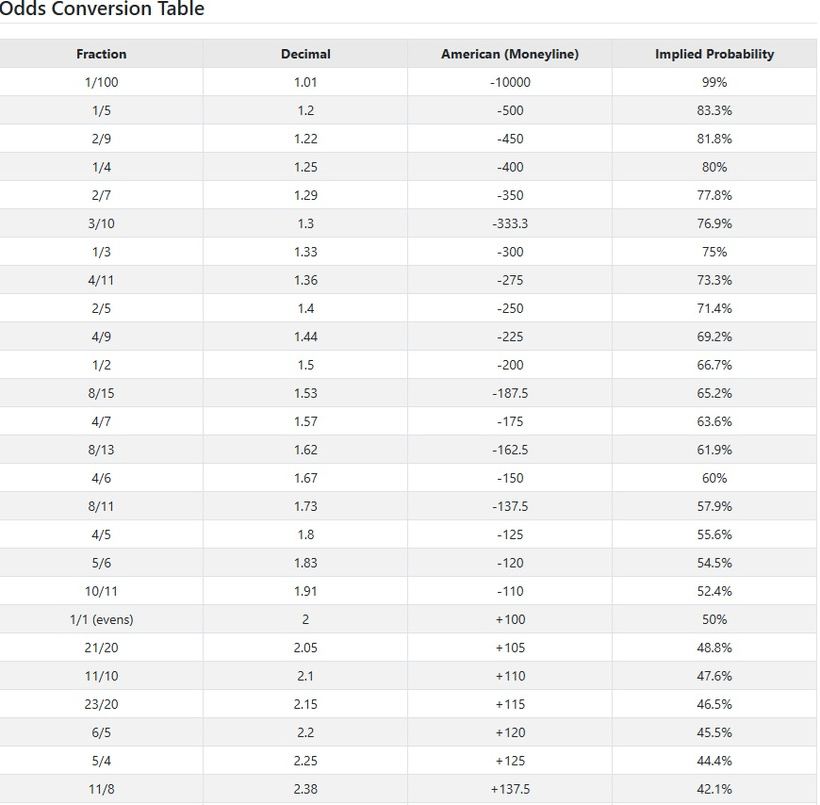
ODDS CONVERSION TABLE
Understanding Odds Movements and Implied Probability
Below is an odds conversion table to help members see how changes in odds translate into real differences in winning probability.
Many people get excited when a horse’s price shortens dramatically — for example, a 100/1 chance moving into 33/1.
However, the increase in implied probability in that case is only 1.9% — far smaller than it seems.
At the other end of the market, a much smaller-looking move — say from 4/1 into 7/2 — actually represents an increase of 2.2% in implied probability.
👉 In other words: A price move from 4/1 to 7/2 is more significant and valuable than a big-looking move from 100/1 to 33/1.