
What Does Well-Handicapped really mean? Betting/Racing Education
Daryl Carter talks about what the term “well handicapped” really means. He wants members to look at well handicapped horses not by the rating next to their name and their last win, but via class decrease and increase.
*Example: Horse A wins his first five handicaps going from a rating of 65 to 95 and as a result moves from Class 5 to Class 2 with his last win coming off 89 in a Class 3 race 0-90 race.
At Class 2 level, he fails to win or place in any of his next five (despite having ideal conditions). As a result, the handicapper drops him from 95 to 88 but his connections remain on the hunt for a good prize in Class 2 level. Is this horse now well-handicapped as he is one pound below his last winning mark? The answer is NO.
Horse A has never shown he can be capable of winning in Class 2 level and despite ideal conditions has not placed. Therefore, despite less weight carrried in Class 2 company, he can’t be classed as “well handicapped” in this grade of race.
Horse A loses a couple of more races and is now rated 85. Connections of Horse A give up the chase of a Class 2 sizeable pot and opt to run him in a Class 4 0-85 off close to top weight. Can this horse now be classed as “well-handicapped”. The answer is YES.
Horse A has now dropped down the handicap to make him eliagable for the class of racing that has seen him to the best effect in the past. He is now tackling lesser horses than the Class 2 race, and he has proven himself at this grade in the past. However, Horse A, has clearly shown he is vulnarable to something with lots of upside, as he couldn’t improve in Class 2 company and reached a cieling of his ability.
Phrases that should be ignored entirely.
“He is two pounds below his last winning mark”
It’s no good if a horse is two pounds lower than his last winning mark if his last winning mark was 73 in a Class 5 and he is now contesting the highest class of handicap in his career in a Class 2 race off 71.
“He is well handicapped on old form”
Old form being the key note in this one. Throughout a horses career they will rise and fall in the handicap system based on current form and level of ability. Usually when a someone says this it’s because they have an affiliation with the horse form a past time – when he was capable of running to a level for example of 99 three years ago, but has shown a clear decline and is now rated 66.
Why Horse’s Have Handicap Ratings!
The Handicapper assigns a horse a handicap rating following two or three runs in Novice and Maiden races. That Handicap rating is simply to determine which class of race and at what level the horse should be competitive at. It will also determine the weight carried by said horse in any class of race.

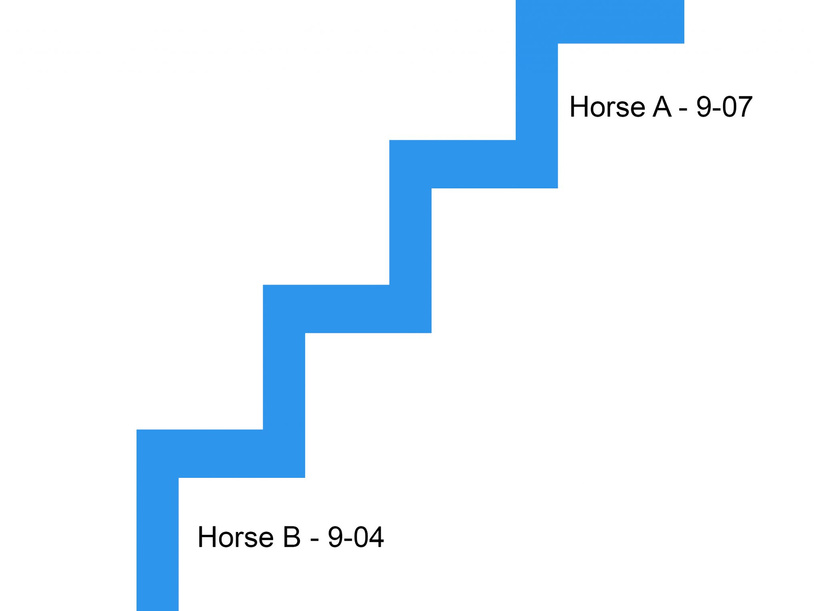
The Handicap System is like a set of stairs. Horses that start off lowly rated will climb the stairs into different grades from Class 6 (Ignore seven for now) up to pattern level.
A lowly rated horse will climb the handicapping system by winning races, and going up in Class. Eventually the horse will be forced into stronger and stronger races to determine it’s true ability. Once that horse hits the cieling of his ability, he will no longer be winning races, and therefore come down the handicapping class system, eventually settling in a grade that he can be competitive at.
Just because a horse has reached a rating of 87, doesn’t mean they must win off 83.
There could be a multitude of reasons for this. Facing unexposed horses, facing a stronger race than even when winning off 87, and so on and so forth.
The ultimate angle for punters to find a well-handicapped horse is versed in the first example. However, horses must have correct conditions to perform to their best, and the number by their name is hardly a pressing factor if in the correct grade.