The Biggest Myth In Betting: “You Shouldn’t Back Overnight”
“Never back a horse overnight” is racing folklore — and it’s costing punters a fortune
“Never back a horse overnight.”
“Overnight prices are for mugs.”
It’s repeated so often it sounds like wisdom. But it’s not. It’s a comfort blanket. And like most comfort blankets in racing, it exists to make losing feel more “controlled”. And you have been brainwashed.
The reality is far simpler:
Overnight betting isn’t reckless. Blind betting is reckless.
And refusing overnight prices as a rule is just another way punters give away value for the perception of others who believe and old wives tale.
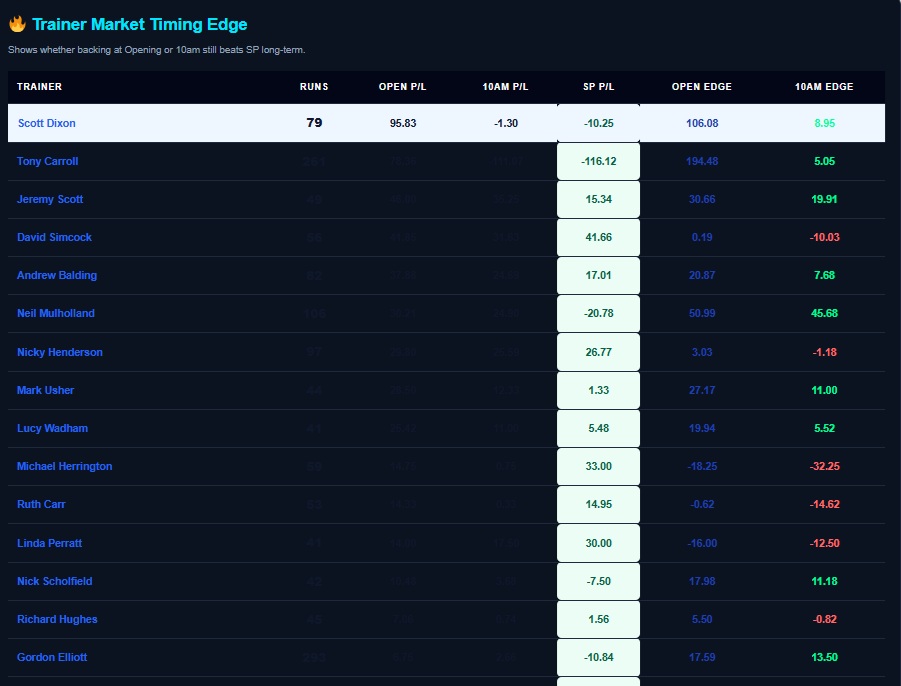
The screenshot proves the myth collapses under data
That Trainer Market Report isn’t opinion. It’s cold, repeatable history.
You can literally see yards where:
- Open P/L is strongly positive
- SP P/L is negative
- and the Open Edge is massive
Example from your table:
Scott Dixon (79 runs)
- Open P/L: +95.83
- SP P/L: -10.25
- Open Edge: +106.08
So what does the “never overnight” crowd do here?
They wait. They feel clever. They feel “safe”.
And they systematically take worse prices about the same horses all because the perception of betting early is frowned upon.
That’s not discipline.
That’s voluntarily paying the market tax for your ego. There is no room for ego’s in betting. If you are happy to get in the back of a que for a sale, knowing the only the first ten customers get the 50% off, then you are not ruthless enough.
“Bookmakers don’t like overnight punters…” — correct. And here’s why.
Bookmakers don’t dislike overnight betting because it’s silly.
They dislike it because opening prices are where the mistakes are.
You are betting against the traders. Of course they want to brainwash you into thinking overnight prices are “against the rules”, it gives them time to correct their mistakes – and we are not talking about one off Rick Waller’s here.
Overnight markets are thinner, less efficient, and far more vulnerable to anyone who understands:
- which connections shorten early
- which horses shorten early
- when the “true” price reveals itself (open, 10am, late, SP)
If overnight prices were “for mugs”, firms wouldn’t:
- react so sharply to early money
- restrict accounts that consistently take early value
- copy price cuts at pace when one firm gets hit
They don’t fear your £10, they fear you as a punter for betting into a low liquidity market, and think you have an edge, and run scared.
They fear you consistently taking 6.0 about something that should be 4.5.
And that’s exactly what timing edges are: repeated mispricing before the market corrects itself.
The biggest trick racing ever sold punters: “Follow the market”
This is where most people get it wrong.
They think:
- “If it’s backed, it must be trying.”
- “If it drifts, it can’t win.”
- “The market knows.”
But data (and DC Network’s tools) prove something uncomfortable:
Following the market blindly is not an edge. It’s a habit.
Because the market is not one intelligent brain. It’s a messy crowd:
- copycat money
- arbers
- shorteners for liabilities
- firms trimming to shape a book
- narratives (“stable gambled”, “well-backed”, “couldn’t get on”)
If you wait for “confirmation” on the majority of races, what happens?
You get the same horse — at a worse price — because the market has already done its job: it removed the value – hence why the bookmakers are happy to allow you to have more on at a later time – they get market confirmation and can adjust their liabilities. Betting first in the market, they shit themselves!
Now here’s the crucial nuance:
The market CAN be useful…
…but only when you know which trainers and horses have repeatable market profiles.
The bookmakers? Love it when you follow the steam – you are too late, they have already adjusted their books.
The edge is not “steamers win”.
The edge is: specific trainers/horses steam early with consistency, and the opening show is the best value.
Old wives’ tales that destroy value (and why they’re wrong)
1) “Trainer form” is everything
This one is poison, because it encourages lazy thinking.
A trainer is “in form” until:
- the winners have been reassessed,
- the handicapper catches up,
- the horses run off their marks,
- the easy opportunities dry up…
…and then suddenly everyone says:
“Trainer’s out of form.”
No. What actually happened is:
the same stable is now running horses that are less well-handicapped.
And each horse is still an individual case.
Trainer form is a blunt instrument. Racing isn’t.
The best punters treat trainer stats like weather:
- informative
- never decisive on their own
If you bet purely because “trainer in form”, you’re usually arriving late — after the market has already priced that angle.
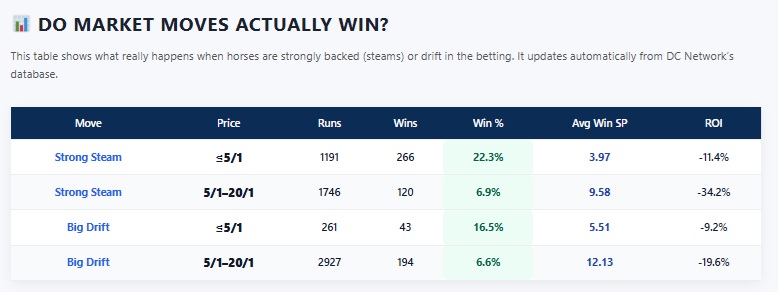
2) “If it drifts, it’s a bad sign”
This is one of the most expensive misconceptions in the sport.
Drifters win every day because:
- price drifts can be book management, not confidence
- liquidity changes distort early prices
- one rival gets backed and the rest drift mechanically
- firms push out prices to attract money on a race they’re lopsided in
A drift isn’t a verdict. It’s information.
Sometimes it’s meaningful. Often it’s noise.
And if your “rule” is never back a drifter, you’re not avoiding losers — you’re avoiding value when the crowd overreacts.
3) “Steamers are always trying”
If this were true, betting would be easy.
In reality:
- false steams are common
- some support is “positioning”, not conviction
- some moves are simply firms copying each other
- a horse can shorten because the early tissue was wrong, not because it’s suddenly a better bet at the new price
Steamers can win.
But steamers at the wrong price are still bad bets.
Again: price first, story second.
4) “Wait until the market settles”
This is just the overnight myth wearing a suit.
Yes, markets become more efficient over time.
But punters misunderstand what that means:
Efficiency is the enemy of value.
The more “settled” a market is, the more the mistakes have been ironed out.
Waiting can be correct only if you historically get a better price on that horse/stable profile.
Otherwise you’re doing this:
- passing the best price
- then congratulating yourself for being “safe”
- while your long-term ROI quietly bleeds out
When the game is to beat the market.
5) “There’s always a best time to bet”
There isn’t.
There is only a best time for:
- this trainer
- this horse
- this owner profile
- this market type
That’s why blanket rules fail.
“Never overnight” is the same error as “always back late money” — just in reverse.
Why overnight prices can be the single biggest edge (when used correctly)
Here’s the key point people miss:
Overnight is where the value exists because the market hasn’t corrected yet and bookmakers are waiting for confirmation of their own prices.
If a yard repeatedly shows positive Open Edge, it means:
- their horses are regularly bigger at the opening show
- and shorter later, often at SP
So the punter who refuses overnight prices is doing something mathematically insane:
They are choosing to bet after the value has been removed.
And that’s exactly what your table demonstrates in black and white.
This often demonstrates a punter is looking for market confirmation, and that means they are weak with their edge.
The real conclusion: timing is not a rule — it’s a profile
So the correct way to think is:
- Some connections are best backed overnight/open
- Some are best backed around 10am
- Some are best backed late
- Some are never a bet at any time
DC Network doesn’t tell people to “follow the market”.
It does something far more powerful:
It proves when the market moves are meaningful — and when they’re just noise.
Your report shows that:
- blindly following SP or late moves is not the way
- the edge is understanding which connections repeatedly offer value early
- and which ones are consistently overbet later
That’s how you stop being the person reacting…
and become the person the market is reacting to.
The final line
Overnight prices aren’t for mugs.
They’re for punters who understand one truth, have an edge that does not need market confirmation, and are willing to back themselves against a traders prices.
You don’t beat the market by arriving after it has corrected itself.
You beat it by taking value before it does.
And our data proves exactly where that value has existed for years.