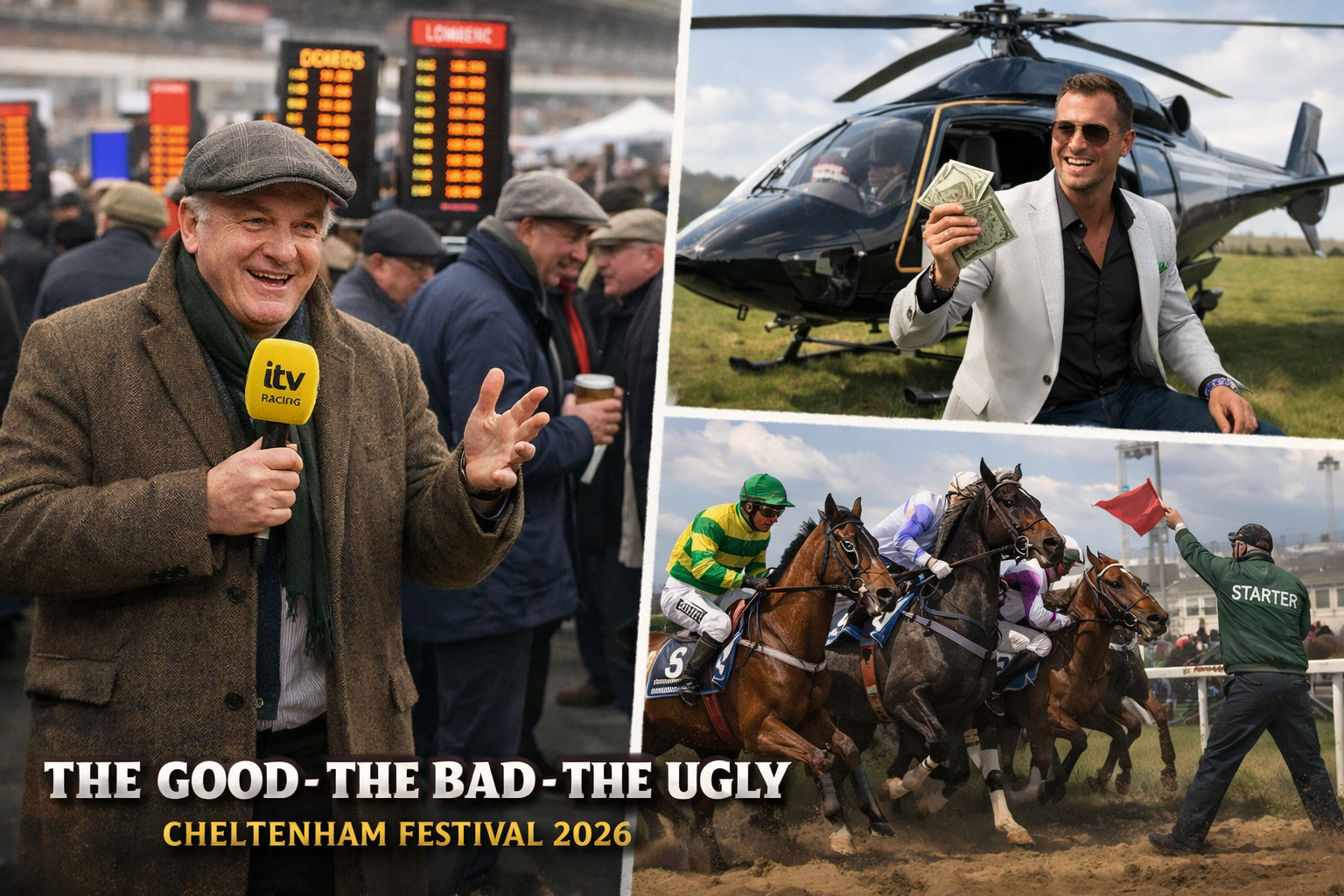
The Good, Bad, and Ugly of Cheltenham 2026
Every Cheltenham Festival leaves a legacy. Four days of racing at the sport’s spiritual home rarely pass without moments of brilliance, controversy, frustration and theatre. The 2026 renewal was no different.
From inspired broadcasting moments and fiercely competitive racing, to the recurring circus of unreliable tipping and the continuing embarrassment of chaotic race starts, the week once again showcased both the best and the most frustrating aspects of National Hunt racing.
Below is a measured look at the good, the bad and the ugly of Cheltenham 2026.
The Good
ITV’s Betting Ring Coverage – A Real Step Forward
One of the most refreshing aspects of the week was ITV’s decision to bring the betting ring to the forefront of the broadcast, and much of the credit must go to Johnny Dineen.
Dineen injected personality, humour and genuine knowledge into what has often been an underused part of racing coverage. The betting ring is not just background noise — it is the pulse of the sport. Watching bookmakers react to plunges, feeling the tension of market moves and hearing traders explain why a horse is shortening or drifting provides insight that racing fans crave.
For too long television coverage has treated betting as something slightly awkward — a necessary evil rather than the economic engine of the sport. The reality is that Cheltenham is fundamentally about betting as much as it is about racing, and ITV’s willingness to lean into the bookmaker-versus-punter narrative made the broadcast both entertaining and educational.
It should not be a one-off experiment.
If anything, the sport should double down on this approach. Punters want transparency and context. The betting ring provides both.
Competitive Racing at the Highest Level
Some critics suggested the Festival lacked a few of the all-time great headline performers this year, but what it perhaps lacked in superstar dominance it made up for in sheer competitiveness.
Time and again races unfolded with multiple contenders turning for home with genuine chances. The margins were tight, the form lines were tangled, and many races were open puzzles rather than foregone conclusions.
Purists may argue that the golden eras were defined by dominant champions, but uncertainty is the lifeblood of betting sport. From a wagering perspective, the 2026 Festival was compelling.
Cheltenham thrives when races feel unpredictable but fair, and many contests this year delivered exactly that.
The Social Media Build-Up
If there is one area where racing continues to evolve positively, it is the digital build-up to major festivals.
Cheltenham week is now preceded by a tidal wave of podcasts, analysis videos, preview nights, Twitter threads and long-form content. Whether it is analysts breaking down sectional times, pundits debating form lines or fans discussing handicaps deep into the night, the online ecosystem around the sport has never been stronger.
The mainstream media alone could never generate this level of engagement. The Festival now belongs as much to the community of racing enthusiasts online as it does to broadcasters and newspapers.
In that sense, the sport should be proud.
The collective passion of racing fans is doing more to promote Cheltenham than any marketing campaign could.
Jockey Arguments – Emotion is Good Television
One of the more widely discussed aspects of the week was the sight of jockeys confronting one another after races.
Traditionally racing has tried to smooth over these moments, presenting a polished image where tensions are quietly managed behind closed doors. But high-level sport is emotional, and when riders have spent two miles battling for position at speed, frustrations are inevitable.
Rather than being damaging, these exchanges serve as a reminder that the people involved deeply care about the outcomes.
Authenticity matters.
Fans relate to emotion far more than corporate polish.
Immediate Jockey Interviews
Perhaps the most valuable development for racing fans and bettors alike has been the growing trend of immediate post-race jockey interviews.
These moments often contain more genuine information than any pre-race preview. Riders explain how races unfolded, whether horses travelled strongly, where they lost momentum, or if something went wrong tactically.
For punters, these insights are gold dust.
They help contextualise form in ways that raw finishing positions cannot.
If the sport wants to improve transparency and deepen engagement, making these interviews standard practice should be a priority.
The Bad
The Annual Tipster Circus
Cheltenham week inevitably brings with it a parade of self-appointed experts. Unfortunately, the Festival also exposes the difference between serious analysis and marketing theatre.
Every year the same characters appear on preview panels offering confident selections that collapse under the slightest scrutiny. The week ends, the losses pile up, and yet somehow these individuals return the following year as though nothing happened.
The most frustrating aspect is not that they get things wrong — everyone does. Racing is difficult and uncertainty is inherent.
The issue is accountability.
Many of these personalities disappear once the Festival is over, leaving punters who followed their advice to absorb the damage. There is no review of performance, no transparency around results, and certainly no apology when hype replaces genuine insight.
Take the case of the hype surrounding horses such as Mighty Park this year. The narrative around the horse was driven less by evidence and more by what could best be described as water-cooler gossip masquerading as inside knowledge.
Yet the same voices that push these narratives continue to position themselves as authorities.
The Social Media Marketing Illusion
Modern tipping culture has increasingly blurred the line between analysis and performance.
Helicopter arrivals, videos featuring stacks of cash, choreographed celebrations and endless promotional gimmicks are presented as proof of success. In reality they are marketing strategies designed to sell subscriptions, not indicators of betting skill.
The truly serious analysts are usually the least visible.
They are in offices, studying form, watching replays and doing the unglamorous work required to find value.
Meanwhile the loudest voices online are often those producing viral videos rather than rigorous analysis.
For newcomers to the sport this creates a distorted impression of what successful betting actually looks like.
The Ugly
The Starts – A Persistent Embarrassment
If there was one element of the 2026 Cheltenham Festival that genuinely undermined the spectacle, it was once again the race starts.
The chaotic scenes at several starts were uncomfortable viewing. Horses circling endlessly, false starts, runners becoming fractious and jockeys struggling to line up fairly have become an all too familiar sight.
From the outside, it makes the sport appear disorganised and amateurish, which is unacceptable at an event regarded as the pinnacle of National Hunt racing.
More importantly, poor starts directly impact fairness.
Punters invest significant money based on form and preparation. Owners and trainers commit months of planning to reach this stage. Yet all of that can be compromised if a horse is caught flat-footed, trapped wide or badly positioned simply because the start was poorly managed.
The fundamental issue is structural.
Starting races around a bend rather than within a clearly defined straight starting zone creates unnecessary chaos.
The solution is obvious:
- Establish a controlled start box or zone
- Prevent circling around bends before the tape
- Ensure horses line up facing the correct direction
- Reduce the amount of jockey manoeuvring required before the off
This is not an unsolvable problem. Other racing jurisdictions manage orderly starts without difficulty.
The fact that this issue continues to plague the Cheltenham Festival year after year suggests the sport has been far too slow to modernise a critical part of race management.
Final Thoughts
Cheltenham 2026 once again demonstrated why the Festival remains one of the most captivating events in sport.
There were moments of brilliance:
engaging broadcasting, fiercely competitive racing, passionate participants and a vibrant digital community surrounding the sport.
Yet the week also exposed familiar weaknesses:
an unregulated tipping culture that often prioritises marketing over expertise, and operational issues — particularly with race starts — that simply should not persist at the sport’s flagship event.
Cheltenham will always be chaotic, emotional and unpredictable. That is part of its magic.
But if racing wants to maintain credibility with modern audiences and serious bettors alike, it must address the structural flaws while amplifying the elements that make the Festival great.
Because when Cheltenham gets it right, there is nothing quite like it.