

(Entry) Betting Education: Expected Returns over 10k Bets

Understanding Expected Returns Over 10,000 Bets: From 10/11 to 100/1
Most bettors judge success by asking “How many winners do I need?” or “How long can I go without a winner?” But the real key to betting education is understanding expected returns, strike-rates, variance, and long-term outcomes.
This guide breaks down what to expect if you place 10,000 bets at the following odds: 10/11, 6/4, 2/1, 4/1, 10/1, 20/1, 50/1, and 100/1.
For each price, we look at:
– Expected strike-rate
– Expected number of winners
– Expected number of losers
– Expected profit/loss at level stakes
– How variance behaves at different odds
– Why long losing runs are normal — not a sign of bad betting
We assume level stakes of 1 unit per bet, no edge, and no overround — meaning prices represent true probabilities. This allows pure education without bookmaker margin interference.
1. Converting Odds to Implied Probability
(Use probability table in betting tools)
Fractional odds → Probability formula:
Probability = Denominator / (Numerator + Denominator)
Examples:
– 10/11 → 11 / 21 ≈ 52.38%
– 2/1 → 1 / 3 = 33.33%
– 100/1 → 1 / 101 ≈ 0.99%
We use these probabilities to determine expected winners.
2. Expected Winners and Losers Over 10,000 Bets
Expected winners = probability × 10,000
Expected losers = 10,000 – expected winners
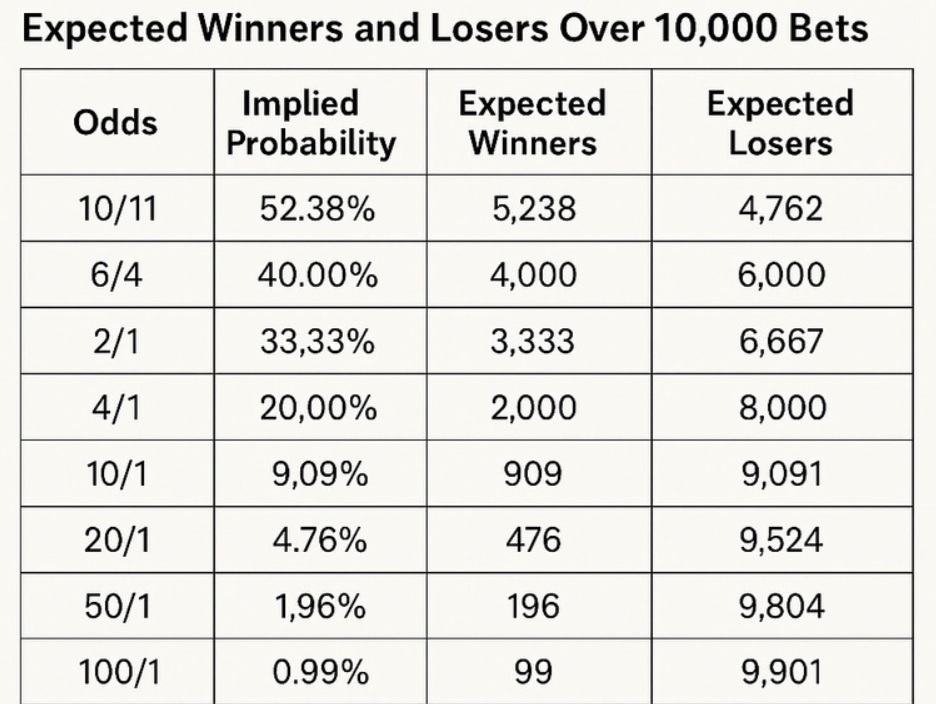
3. Expected Return at Level Stakes (No Betting Edge Assumed)
If odds reflect true probability, then expected value (EV) is 0 — meaning you break even long-term before bookmaker margin. (See EV article)
For example:
Bet 1 unit on 10/11
Expected win probability = 0.5238
Profit on win = 0.909 units (since 10/11 returns 1.909)
Expected return ≈ 1.00 unit.
The same holds at all true-odds prices. Therefore, over 10,000 bets at any of these fair odds:
Expected total return = 10,000 units
Expected net = 0 units
But this does not mean all odds behave the same in practice. Variance radically changes your real-world experience.
4. Understanding Variance: Why Odds Feel Different
Variance is how much results fluctuate from expectation.
Low-odds bets (10/11, 6/4)
– Small fluctuations
– Long losing runs are rare
– Bankroll moves more smoothly
Mid-range odds (4/1, 10/1)
– Losing runs become significant
– Month-to-month volatility increases
Longshots (20/1 to 100/1)
– Results become extremely lumpy
– You can be on the right strategy but lose for months
If a bet has a 50% chance (EVENS), standard deviation is low. If it has a 1% chance, standard deviation is huge. This is why backing 100/1 shots feels chaotic unless your betting bank is huge and your discipline very strong.
5. Expected Losing Runs at Different Odds
A simple approximation shows that the longest losing runs get dramatically worse as odds get bigger. For education, here is a useful range (SEE SECOND TABLE):
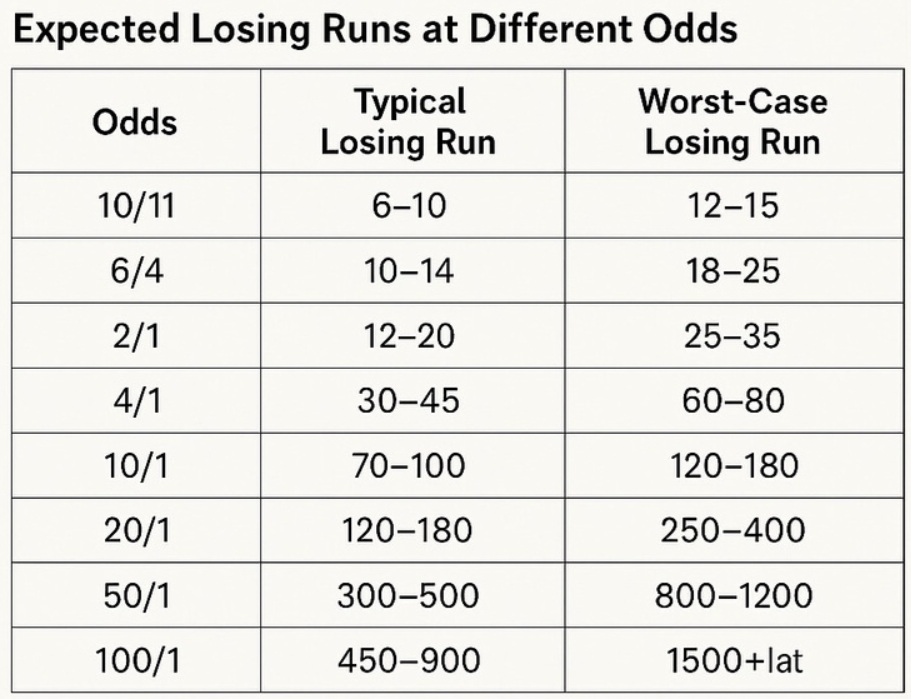
If you bet at 50/1 or 100/1, losing 500 straight bets does not automatically mean you are unlucky or betting badly — it can be statistically normal.
6. Expected Profit/Loss Over Shorter Periods
Even if EV = 0, your actual results will vary hugely (See EV article)
Short prices → low variance
If you bet 2,000 times at 10/11, you will likely end up near breakeven (within roughly ±5–10%).
Mid prices → moderate variance
At 4/1 over 2,000 bets you could easily be 20% up or 20% down (or more) but also hit a losing run of 60-80 bets.
Longshots → very high variance
At 50/1 over 1,000 bets you may hit 0 winners, 1 winner, 5 winners, or 10 winners. The outcomes are widely spread, even though expectation says you “should” hit around 20 winners over 10,000 bets.
7. Key Takeaways for Bettors
1. Odds dictate strike-rate.
2. You must choose odds that match your temperament.
3. Long-term thinking is non-negotiable.
4. Losing runs do not automatically mean poor betting.
5. Understand your edge.
6. Bankroll management is everything.
8. The Big Picture: What 10,000 Bets Teach You
Odds | Expected Winners | Key Lesson
10/11 | 5,238 | Solid stability but small edges matter a lot
6/4 | 4,000 | Variance noticeable but manageable
2/1 | 3,333 | Losing runs grow; discipline required
4/1 | 2,000 | Bankroll must absorb 50+ losing runs
10/1 | 909 | Patience is vital; variance is major
20/1 | 476 | Rare wins; months of losing possible
50/1 | 196 | Results are lumpy; many bettors quit
100/1 | 99 | Drastic variance; only for specialists
Long-term numbers stabilise over 10,000 bets — but your real experience varies dramatically based on the prices you play.